Sepia Stories Part 16 – Day 1848

By Uncategorized

Whenever I am asked what I enjoy most about my profession, it does not take me time to respond that I’m here because I like writing and I like films and my profession provides me with an opportunity to dabble in both.
My book Cinema: Images and Issues are my observations and essays on cinema, some explored as academic study and some, stored as stubborn memory of celluloid that refuse to fade.
The issues came in later, after I had sufficient exposure and the confidence to disagree and debate. A film evokes different responses in different people and perhaps that is the essence of cinema, to break illusions and conjure new images.


The essence of leaders is to inspire and a memorable feature in the book is a story narrated by our late President Abdul Kalam at the golden jubilee celebration of Sangeet Natya Akademi Awards. Kalam was the chief guest at the event and recalled a special morning at the Rastrapati Bhavan, when he noticed a carpet of jasmine flowers fallen from a tree into the garden. As Kalam changed his path to not disturb the flowers, he imagined a conversation between the mother flower and the baby flower.
The baby flower, unhappy to lie on the floor asked the mother why they must go through the effort of blossoming when they are going to be trampled over anyway. The mother gently explained to the child that a deer does not stop loitering in the forest worried about the tiger, nor does the bird stop flying in the sky because it fears the beast, ‘Our reason to blossom is to reduce cruelty in mankind.’.
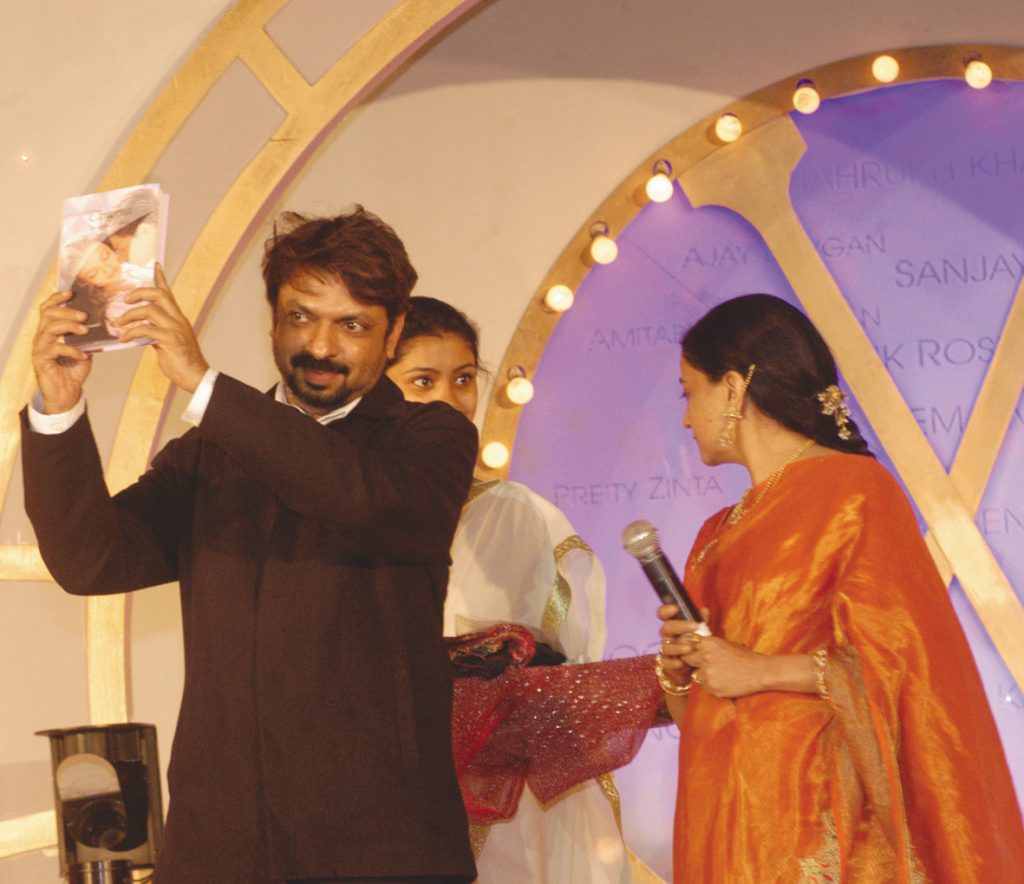
“Artistes” concluded Abdul Kalam are like the blossoming flowers spreading fragrance in society and a nation that does not value its artistes can never prosper. Cinema:Images&Issues published by #Rupa was released in Mumbai by #SanjayLeelaBhabsali and by #KirronKher in #LosAngeles
To be continued.
Sepia Stories Part 14 – Day 1846

By Uncategorized

The 90s were full of surprises. The emerging sex symbol of showbiz Kimi Katkar quit films to get married to ace photographer Shantanu Shorey. Shantanu said what attracted him to Kimi was her honesty. By the end of the decade many more got married including Meenakshi Sheshadri.

Rishi Kapoor was going through career conflict and unable to decide if he should direct a film or shift to character roles. He sounded like a broken record in all his interviews complaining about boring roles he portrayed on screen, so I interviewed his wife instead discussing his irritating habits. When the interview appeared in print Kapoor was mad at both of us and denied he was as difficult as he is made out.

After Sridevi and Jaya Prada, it was time for South filmmakers to try their luck in Hindi films. Mani Ratnam with Roja and Bombay and Ram Gopal Verma with Rangeela. Kaml Haasan was struggling too but without much luck.

Aamir Khan and Pooja Bhatt the new pair of Bollywood fought like Tom and Jerry during a photo shoot together and by the end of the session, photographer Gautam Rajadhyaksha and I had a migraine. I interviewed Aamir Khan on our way to the funeral of Manmohan Desai and when I remarked that Salman and Shah Rukh overtaken his career, Aamir smiled and said, ‘The race is not over as yet’.

Senior actresses Jaya Bachchan and Kirron Kher were back to the arc lights with Hazar Chaurasi Ki Maa and Khamosh Paani and both received critical acclaim. So did Rekha and filmmaker Basu Bhattachary for the bold and daring Aastha the story of an unusual homemaker.

Director Deepa Mehta arrived from Toronto to serve India its first lesbian film Fire and even though everyone was certain that the film will be rejected by the censors, it was passed but on release there were riots at the cinema halls.

Saif Ali Khan and Amrita Singh confused themselves and the media by first denying their link up and later marriage. It was a turbulent time for Anupam Kher who for some reason or the attracted hostility from the media 
Post Hum Aap Ke Hain Kaun or a little before that Madhuri Dixit had taken over Sridevi on the number one position. Sridevi who was slowly and gradually shifting to performing roles like Mahesh Bhatt’s Gumrah.

Sepia Stories Part 13 – Day 1845

By Uncategorized

The 80s was the decade of multi-starrers and double shifts. Zeenat Aman was a leading star running second to Hema Malini at the box-office. Zeenat called herself a professional and the heroes scoffed at her for not being emotional. Today, emotions have no place in show business and if you are not professional you have lost the race before you have begun.

All the leading ladies of that era longed to work with Gulzar but not the heroes, they felt he made heroine-oriented films. My interview with the writer was about his films and his poetry and Meghna Gulzar, a school going kid at that time, scribbled her first poem as part of my story on her writer father.

South superstars Sridevi and Jaya Prada were introduced in Hindi films but had to still adjust to the razzle dazzle of Bollywood. Jaya Prada described Mumbai as a city that never sleeps and Sridevi was confused why everyone addressed each other adding Ji.

It was the era of star sons, Dharmendra was launching Sunny Deol, Manoj Kumar was launching Kunal Goswami and Raj Kapoor was launching Rajiv Kapoor. That’s why Subhash Ghai decided to backup an outsider Jackie Shroff, only Anil Kapoor had no godfather and therefore worked harder than everyone put together.

The new heroines for the star sons were Poonam Dhillon, Meenakshi Sheshadri, Rati Agnihotri and Anita Raj.
Dev Anand was launching new faces and new films, Shabana Azmi the fiery actress of parallel cinema was showing the first sign of a blooming activist and Rekha, in a surprise move had stopped talking to the media.

Sepia Stories Part 12 – Day 1844

By Uncategorized

The 70s was a volatile decade. Filmmaker Hrishikesh Mukherjee was the man the media loved to hate because of his close association with superstar Amitabh Bachchan, then inaccessible to the press. I did a nostalgic interview with the director that left little chance for provocation.

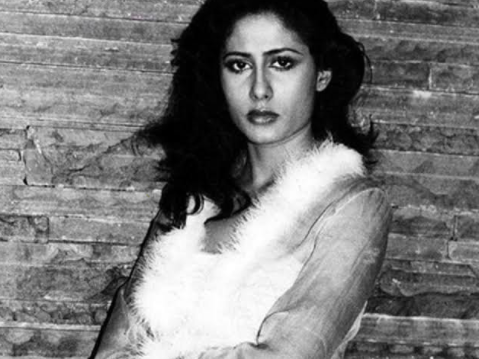
Smita Patil was Shyam Benegal’s new discovery in Nishant after Shabana Azmi in Ankur and the media was curious about her. She gave unconventional interviews which was one of the reasons she was frequently featured by the glossies. The other reason was she looked stunning in her pictures. Going through the predictable phase of being unable to decide whether to do commercial films or stay with art house movies, Smita made contradictory statements that resulted in controversies.

Aruna Irani was eternally in love and always with the wrong man and we spoke about how and why the rot sets in a relationship, a soulful conversation that haunts to this day.

Shashi Kapoor was riding high after a long time and elder brother Raj Kapoor with whom he was shooting for Satyam Shivam Sundaram called him a taxi because he allotted three hours of shooting time to different shifts. My assignment of a nine-day diary was conducted during this frenzied phase when he was building Prithvi Theatre and shooting Junoon.

Rajesh Khanna was in the process of losing his position but had to still come to terms with it. Looking back, it was brave of Khanna to agree to the week-long diary for he knew I could see the chinks in his armour.

Rishi Kapoor and Neetu Singh had confirmed their marriage after a long courtship, the wedding was the most talked about event of the decade, I spent a day with Neetu capturing her feelings…
To be continued

Sepia Stories Part 11 – Day 1843

By Uncategorized

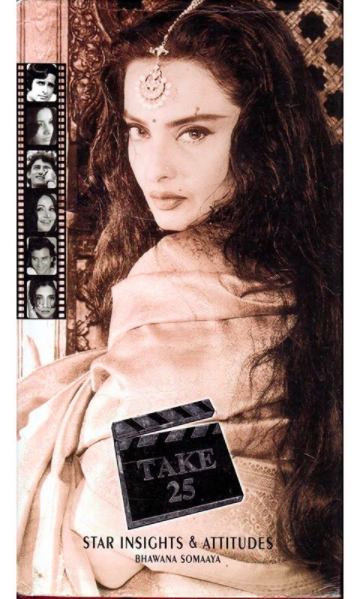
The idea for Take 25 came to me when I was clearing the attic at my old home and came across a suitcase preserved with cuttings of my published stories over the decades. This was before the computers came in naturally. I was filled with nostalgia re-reading the old quotes even though I did not identify with it anymore. Would the actors I had interviewed years ago, also feel the same way, I wondered and if not, is it fair that their expressions- sometimes volatile and emotional are archived forever?

The interactions and the issues raised reflect a significant phase in the actor’s career and also the operative influences on the journalist representing the publication at that time, still, the final responsibility of the spoken word at all times rests with the artist. The quotable quote has a way of bouncing back into print, and always, when the star is going through a vulnerable phase.

Rekha has confessed that she no more identifies with her impulsive statements of the past. I’m sure most of them feel the same way, it is because words have a culture of their own and can annoy and make you anxious like people.
Sharmila Tagore has a solution for the ongoing conflict, she says that if at all time she is going to be held accountable for everything she speaks, then he’d rather refrain than regret her words. That should be a lesson for life for all actors.

Take 25 published in 2002 are my conversations with actors conducted over two and half decades of my career, when journalists recorded interviews on portable tape recorders and typed manuscripts on manual typewriters. Gradually as floppy discs and matchbox Dictaphones made way for computers and pen drives, my interest shifted from intimate conversations to the craft of cinema. Earlier I assessed the stars and filmmakers with personal observations, now I discovered them through their work, sab time time ki baatein hain, more about it tomorrow…. Cover Pic: Jayesh Sheth @jayessheth

Sepia Stories Part 10 – Day 1842

By Uncategorized

Amitabh: The Legend went into several reprints and was translated into Hindi and other languages. The 361-page book has some exotic pictures of the actor and insightful interviews from his family but my favorite memory of the book is a diary where I spend seven days observing the actor at work, on the sets of Khuda Gawah at Mehboob Studio.

The motive of the feature was to gage an artist at work, his anxiety, his fatigue, his reactions before the camera and when the lights went out. To observe and comment on what annoys him and what makes him smile, does he feel weighed down after a strenuous scene..?

What does he eat during the lunch break, does the food come from home or does he eat the studio food? Does he take a power nap post lunch or does he move from studio to studio without a break?

Is he interactive on sets, in between shots or does he keep to himself? Does he drink tea/ coffee/ nimbu paani or nariyal paani in between meals? Is he nervous before a take? Does he rehearse his scene before the unit or in the privacy of his makeup room?

I cannot guarantee I found all the answers but observing the actor over a week was a learning experience. Picture shot at #OutofTheBlue, Mumbai

Sepia Stories Part 9 – Day 1841

By Uncategorized

Bengali director Rituporno Ghosh who had not yet become the star of Bengal, was in Mumbai on that day of the book release and asked me if he could attend the event because he would like to see Amitabh Bachchan in person.

Ten years later, Rituporno Ghosh worked with Bachchan in The Last Lear and had he not gone away as suddenly as he did, the two would have probably made a few more films together.

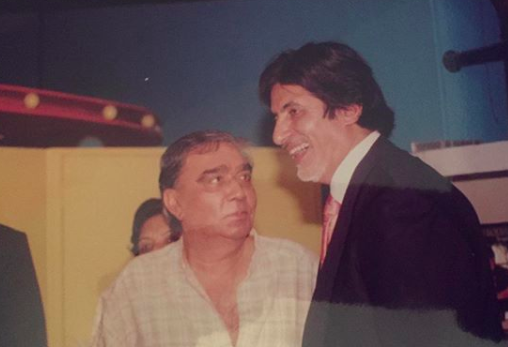
The most distinguished guest in the audience that evening was Urdu poet Ali Sardar Jafri and his wife Sultana Jafri. Every time I see this picture, I want to kick myself that I did not invite him on stage to release my book. There could have been no bigger honour than to have the erstwhile poet release the book of the son of a poet but since this was my debut as an author, I was still not familiar with the ways of book publishing and hesitant to make suggestions.

On second thoughts, the book could have been jointly released by Bachchan’s three filmmakers (Yash Chopra, Prakash Mehra, Ramesh Sippy) in the audience but the nineties were an innocent decade when topline filmmakers were happy to be your guests with no expectations of spotlight.

Post the release, Bachchan waited and signed copies for readers. We were happy to see a long line of them to get their copies autographed until we discovered that all the display copies on the stands were missing.

That’s another lesson I learnt from the event, never ever display books at a launch because it is difficult to keep track of the copies.
To be continued

Sepia Stories Part 8 – Blog Number: 1840

By Uncategorized

I’m often asked how I conceived the idea of The Legend and my answer is that it is an unplanned book. Bachchan had imposed a ban on the media for more than fifteen years and in the year 1990 one day in a surprise move he began talking to journalists.

Sometime in 1997 when I was doing a cover story on him, my secretary commented that I must not do any more stories on the actor because she had exhausted all permutation-combinations to name these files. This was an indicator for me to revisit the files and I discovered that I indeed had a lot of material on the actor.

Like any disciplined writer, I began to find a structure to save these stories and saw it taking the shape of an engaging chronicle. When I was ready with the final copy, I shared it with my magazine publisher and it was Maulik Kotak’s suggestion that I combine the text with pictures from our archives and create a dummy.

Art director P G Ghawali of g magazine designed the manuscript as a book and the production department bound it all together. The entire exercise occurred so naturally and so harmoniously along with our regular work that none of us questioned the motive behind the creative pursuit.

The next step was to share the idea with Amitabh Bachchan and to tell him how it originated and when he gave the nod everything fell into place. Amitabh: The Legend is among the early books on the actor, the first biography structured in question answer format to retain the superstar’s voice.

To make the book comprehensive I met up with all his filmmakers and heroines and all of them from Hrishikesh Mukherjee and S Ramanathan to Rekha and Raakhee, recounted unusual memories of the actor, I guess when something wonderful has to happen, everything falls into place.
To be continued